So I finally quit using Blackberry last week after planning to do so for some time. The device has outlived its purpose for me and I was hardly using BBM. I was planning to hang on to it until the next iPhone is launched because my mother just joined the BB craze late a few months ago. Unfortunately, recent circumstances have rendered me unable to postpone any longer. However, despite my switch and general dislike of RIM and Blackberry, I feel like the Blackberries I used and my time with them deserve this fond look back.
My earliest recollection of learning about Blackberry was when I was still in college in US a few years back. Back then, Blackberry was THE mobile phone that many Americans use. As someone from Asia who's used to seeing cool, sleek, small mobile phones from Nokia, I just had to laugh at those big, bulky Blackberry with full keyboards. It doesn't help that I used to scoff at many things that only Americans do and the popularity of Blackberry over there is one of those things that symbolized what's wrong with America for me. Of course, back then, I didn't know that Blackberry had robust email service that is popular with professionals and enterprise market which counted for their success. I also didn't foresee that karma will catch up to me when I returned to Indonesia in 2009.
My first Blackberry phone, the bold.
In late 2008s/early 2009s, just as Blackberry was starting to fade in US due to iPhone's rise, it became massively popular in Indonesia against all odds and logic. This sudden success is due to an unexpected cause: Blackberry Messenger (BBM). Before Blackberry took off, Indonesians used their mobile mainly to text/SMS on cheap SMS plan. With BBM that comes with all Blackberry, the chatting is faster and always online and the killer deal is that BBM use does not count against the data plan (compared to using MSN/Yahoo IM Messenger mobile client) - so using BBM to chat is "free", even more "free" than SMS. Pretty soon, everyone starting from the rich and famous started buying and using Blackberry devices (the popular one was BB Bold 9000) and it trickles down to middle class or everyone who can afford it. Then, everyone with Blackberry stops asking for phone number and ask for PIN instead. It was easy to feel left out and people just had to get these costly BB device and the data plan which isn't exactly cheap either. It was not uncommon to see everyone sitting in the same big dinner table having or using a Blackberry. In no time, Blackberry has become Indonesia's national phone. Remember that this is a phone that was designed for its email and security strengths for professionals, but it took off in general market in Indonesia due to its chatting program. It's just one of those things that can only happen in Indonesia.
My second and last BB phone curve 3G, after the first one was stolen.
Amidst the rise of Blackberry culture in Indonesia, this is also the story of me coming back home (I was laid off at the end of 2008 and had to leave US due to visa issues) and starting a long distance relationship with my then-girlfriend. When Blackberry became too popular, I had to swallow my pride and get a Blackberry too. Thankfully, to smooth things over, my then-girlfriend also got one (can't remember who got first). I got myself the ubiquitous Blackberry Bold 9000, which look I like and thought that it showed a stylish maturity for the device makers after years of making ugly devices. But I hated the lag, the shoddy trackball, the frequent Java errors, the battery hog that made me wish to go back to my Nokia instead. But all that are forgotten when I used it to communicate with my girlfriend. While we used all sorts of tools available to maintain our relationship, including IM, phone and skype, BBM were used the most by us. I believe that 70% of our interactions happened in BBM. Chatting session would usually occur around lunch my time and before bed her time. We chatted so much that I remember feeling anxious if I don't receive any BBM message for a long time - I guess that's how it feels to be own a crackberry. The relationship that lasted over 2 years was aided as much as possible by Blackberry and its messenger to its bitter end is a testament on how wonderful technology has become. If we end up getting married, I would personally thank Blackberry in my speech and raise it up to the crowd for making the wedding happen, seriously. Too bad the relationship ended and was never meant to be. All the jokes, gossip and serious conversations over 2 years with her that happen through the window of 2 Blackberry devices I owned may have been forgotten, but I'll never forget the fact that they occurred in my life and for that I'd like to thank Blackberry for having been an important part of my life.
As far as I can remember, from the time when the Korean Wave started in the early 00s, I have never finished watching a Korean TV Drama. I have only watched the following titles: Hotelier, Attic Cat, Love Story in Harvard and What Happened in Bali and only liked the first two but never finish any of them. This is because I tend to find the script and production values to be similar to Hong Kong/Taiwan standard but poor compared to their cinematic counterparts, which is shocking considering how popular they are. It seems that most Korean dramas tend to rely on their stars and overly melodramatic and unrealistic soap opera plotlines to attract their core audience, of which I just simply don’t belong in.
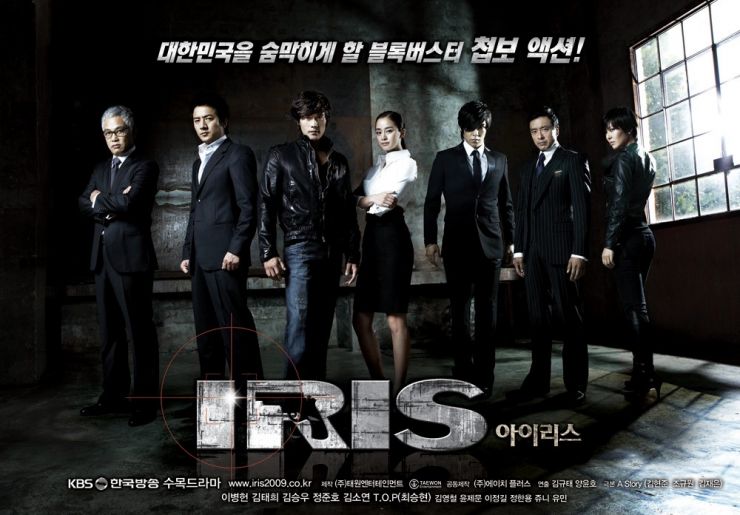
Therefore, it is with great interest and curiosity when I learnt the existence of the drama IRIS, because of Lee Byung-Hyun participation in it. By 2009, Lee Byung-Hyun has become a top film actor internationally, fresh off starring in the Hollywood blockbuster GI Joe. It therefore begs the question why he would choose to return to Korean television after all that success. Is it money? Is the material good? If it happens to be both, could this finally be a Korean drama that’s worth watching for me?
Plot:
Kim Hyun-Jun (played by Lee Byung-Hyun) and Jin Sa-Woo (Jung Joon-Ho) are best friends and two of the finest soldiers serving in the South Korean military. They are then scouted and recruited to join NSS – the South Korean version of CIA – by the beautiful agent Choi Seung-Hee (Kim Tae Hee). At first, everything seems to go smoothly for them as they foil an assassination attempt at the new South Korean president by the North Koreans and Hyun-Jun manages to date Seung-Hee (much to the dismay of Sa-Woo). However, after a botched operation in Hungary, Hyunjun is suddenly betrayed by NSS and wanted by both the South and North Koreans. Forced to go on the run and separated from the woman he loves, Hyun-Jun vows revenge and along the way, he discovers the existence of a secret organization called IRIS.
IRIS has existed since the end of the Korean war and has members deep inside both the North and South Korean government. They have been involved in a vast conspiracy manipulating the current affairs of the 2 countries for decades – one of which involve the mysterious death of Hyunjun’s parents – to ensure that the Koreans will never be reunited and the organization will forever profit from the never-ending conflict. With the new South Korean’s president’s heart set on a serious Korean reunification, IRIS has planned a big terrorist attack to prevent that from happening. Hyunjun has no choice but to form an uneasy alliance with 2 former enemies and North Korean agents (Kim So Yeon and Kim Seung Woo) to stop IRIS once and for all, even if it pits him against the woman he loves and his former best friend.
Review:
IRIS is indeed the most ambitious Korean TV Drama ever made at the time: costing 20 million US Dollar, shot in multiple countries across 2 continents, with a famous lead actor fresh off a Hollywood blockbuster and last but not least, it attempts to do a serious spy action thriller - a genre perhaps never done before on Korean TV. I am happy to report that the end product is a high quality TV drama well worth watching, if you can get past some initial issues related to it being a Korean TV drama.
The biggest problems with IRIS are that it has to follow certain K-Drama conventions and that it sometimes feels like a product that has to show its money’s worth to the investors. This is particularly obvious in the first 5 episodes or so – where the production values, writing quality is as bad as other typical Korean dramas. In the beginning, Hyun-Jun is still a young military kid who goes to college and flirts with pretty girl Seung-Hee who’s secretly evaluating him as a possible agent material. These meet cute early scenes can test your patience and makes you wonder if this is just going to be another cheesy Korean drama. It is also embarassing to see Lee Byung Hyun go from being uber-cool in GI Joe to see him attempt being a college kid in a Korean TV drama.
The series, in the beginning, also tend to switch tone suddenly from serious to cheesy/corny romance in a second. This is particularly true during the scenes where Hyun-Jun and Seung-Hee starts dating and they go to Akita, Japan for vacation while their best buddy Sa-Woo is on a mission in Hungary. A 5 minute action scene in Hungary can be followed by a 15-20 minutes scene where Hyun-Jun and Seung-Hee enjoying themselves with the beautiful snow scenery and both of them romancing and acting cute around each other. Obviously these scenes are obligatory for the good people in Akita, Japan who have generously allowed filming in exchange of heavy promotion as well as the K-Drama fans who expect this kind of romance. But these are also scenes that will make producers of 24 and Alias cringe and faint. Lastly, like another K-drama, it will never let you forget that there’s a love story going on by replaying the same 3-4 love ballads in almost every episode, and oh, when T.O.P makes an appearance, a Big Bang rap song is never far away.
But if you can get past all these problems (which only happen in the beginning anyway), what you’ll find is a compelling, believable and entertaining spy thriller. It may not be comforting to Korean people, but one of the best things that come out of the Korean conflict is a rich source for good drama just like the cold war for the American culture. The writers of IRIS may have liberally borrowed from 24, Bourne films and Tom Clancy and even Korean movies like Shiri, but they have also integrated them with the current Korean conflict well and smartly enough, particularly with the idea of a Korean version of Illuminati-like secret organization, that results in a fascinating spy thriller tale that can stand on its own.
The writers are also smart enough to use the conventions of a spy thriller genre to put a fresh spin on the dead tired star crossed lovers cliché in Korean soap operas. Whereas a typical K-Drama will usually have the two lovers separated due to family issues, mistaken identities and god forbid another fatal disease, IRIS cleverly uses a convention of the spy genre – a failed operation and mistaken deaths – to separate Hyunjun and Seunghee for more than half the episodes. It’s not terribly original, but I though the way it’s handled is quite refreshing and actually manages to make us root for their reunion.
There is also an undercurrent of nihilism and futility beneath the drama as a result of following the spy thriller genre conventions, similar to 24. Characters die left and right and get replaced endlessly as the conflict never ends as both sides refuse to give up no matter what. Characters that start out loyal to their countries end up questioning if their loyalty is worth it and for whom is their loyalty truly for. Even fitting for a Korean drama, lovers get separated and more than one love is unrequited. These dark themes make the drama stand above the rest of the others that are only interested in exploring “true love” again and again.
Cast and Characters:
Lee Byung-Hyun as Kim Hyun-Jun
Despite being the lead actor and the main star attraction, Lee Byung-Hyun only does the minimum to make the audience care about his character. This is not a knock against him, but the character Kim Hyun-Jun is just your standard brooding hero seeking revenge against those who wronged him and Byung-Hyun mostly plays him in a subdued, angsty, sad mode. Fortunately, the character is surrounded by interesting characters that make his character arc interesting. At least his film experience makes him look good in action scenes and whenever the occasion requires him to pander to K-Drama fans, he can also flash a wide charming smile in an instant and cry convincingly on cue. But this is not a role that he will be remembered for in his career.
Kim Young-Chul as NSS Vice-Director Baek San
Not a well known name, but Kim Young-Chul takes the honor of being the best actor in the series with his excellent performance as the villain. Baek San is the leader of NSS who recruited Hyun-Jun into NSS and betrayed him, revealing himself to be a high-ranking member of IRIS. He is cold, manipulative, cunning like a snake around the President and his strong loyalty to IRIS makes him a dangerous and fascinating villain to watch.
Kim So-Yeon as Kim Seon-Hwa
This is perhaps the most interesting, complicated and best realized character in the whole series. Kim Seon-Hwa started as a tough North Korean adversary to Hyun-Jun but circumstances forced her to abandon her country and work together with Hyun-Jun. Along the way, she reveals hidden kindness beneath her tough exterior and develops unrequited feelings for Hyun-Jun. She makes most of the difficult decisions throughout the drama and her complex relationship with Hyun-Jun is perhaps the best thing that drives the series emotionally. Actress Kim So-Yeon, previously famous for being in All About Eve, aces this role both emotionally and physically – unlike the lead actress, she actually looks good with guns and fights. It’s also credits to the writers that the relationship is treated with utmost respect and never goes over the top. If there’s any complain about her is that her role gets unceremoniously reduced to being Hyun-Jun’s driver and action buddy as the series draws to a close.
Kim Seung-Woo as Park Chul-Young
I fondly remember him as “Manager Han Tae-Jun” in Hotelier. However, like Lee Byung-Hyun, his character suffers from being too standard– he’s just another general who is loyal to his country and is willing to do anything for it and there’s not much the actor can do beyond that.
Jung Joon-Ho as Jin Sa-Woo
As a best friend turned rival to Hyunjun, this is the most predictable character in the whole series, despite going through a lot of character development in it. This is because the actor (and perhaps the writer too) play him as too much of a pathetic Mr Nice Guy and if you have watched enough dramas, there is no doubt where he’ll end up. It’s a pity because the character is a little interesting and the actor does work hard portraying him.
Kim Tae-Hee as Choi Seung-Hee
Where to start? Firstly, there’s the fact that from the beginning the audience is supposed to buy her immediately as this beautiful, intelligence and tough female secret agent. Then a few episodes later, she falls totally head over heels for Hyunjun, her subordinate, just because Hyunjun flashes his Lee Byung-Hyun mega smile and forced her to kiss him. Too bad Kim Tae-Hee is only pull off the part of being beautiful. There’s also the added embarrassment that she never looks convincing at all with guns and there are many scenes that require her to do that that just fall apart. Worst part is her acting. I once read a review of a Korean martial arts fantasy starring her called The Restless on lovehkfilm.com. The reviewer has this to say about her acting: “The lovely Kim Tae-Hee … appears to possess only one facial expresion: a deer-in-the-headlights look meant to channel horror, surprise, disgust, fear, wonder, and probably happiness, hunger, and arousal too.” I am sad to report that 5 years on, this still has not changed in the series. At least in the series she is only required to mope after Hyun-Jun mostly which isn’t hard to do.
T.O.P as Vick
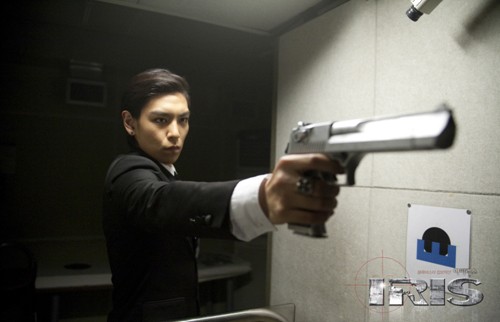
And then there’s T.O.P from Big Bang, a stunt casting decision by the producers to court the young K-Pop crowd. To his credit, T.O.P does have that inhuman quality in his look and he is very effective at looking cold, emotionless and sadistic whenever he kills someone. But then again, he is T.O.P from Big Bang and there’s always a Big Bang rap song that follows him around.
Verdict:
IRIS has everything for everyone: there’s an amazing cast lead by a big Korean star for the Korean pop culture fans, there’s a good spy thriller story for people looking for something serious, there’s the usual trappings of K-Drama romance for existing fans, there’s TOP for those younger K-Pop fans and there’s even snowy Akita, Japan for those looking for nice touristy place to gaze at. I guess what I’m trying to say is watching this most ambitious Korean drama ever made is perhaps also the best way to introduce people who has never watched or hates Korean drama to watch them without turning off the existing K-drama fans. Despite some flaws this is a perfectly fine series for everyone, but one wonders there’s a better spy thriller in here had the producers even go more daring than it already is now. – 3.5/5
The signs that The Tourist wouldn't turn out good is there in the poster. The pairing of 2 of the current hollywood's top actors now are curious at best, mismatched at worst: Johnny Depp who's normally doing wacky roles and Angelina Jolie who's usually into more serious roles. But the pairing is not what causes the film to fail. In fact, Depp does well in a welcome change as an ordinary joe stuck in an extraordinary situation and Jolie does her usual unattainable beauty role, although she does look old here. However, the worst failings of The Tourist is that its script (credited to 2 oscar winners) is simply too by the book and predictable. Even worse is as a travelogue film that shoots in Venice, the scenery aren't good enough to compensate. This seems to be a hollywood reel for director Florian Henckel von Donnersmarck, who previously directed the clinically efficient but cold The Lives of Others (which won best foreign film oscar). But sadly, the monotony of the film doesn't make it a good reel either.If you want to see a better film about an american stuck in Italy, watch The American. - 2.5/5
A hilarious comedy that succeeds because of how many unexpected pleasant surprises are there in store. Who'd have guessed that Russell Brand is capable of showing some humanity while playing (or just being a variant of himself) an obnoxious rocker? Who'd have guessed that Jonah Hill is capable of doing a straight man considering that many of his roles so far only consist of being borderline annoying friends in Judd Apatow movies? Who'd have guessed Sean "P. Diddy" Combs could be so funny? Even a normally serious actress Rose Byrne gets to go against type to hilarious results.
Writer/director Nicholas Stoller returns in this follow up to his previous Forgetting Sarah Marshall. But the confused emotions that hamper FSM doesn't happen here, which makes this comedy gold another great outing from Judd Apatow factory. - 3.5/5
Twilight is a good example of an unlikely good movie can be made from a mediocre source material when a smart and talented director is in charge. It's easy to dismiss the adaptation of Stephanie Meyer's phenomenally popular novel about the romance between a teenage girl and a vampire as nothing but another laughable, cringe-inducing entry to the teen supernatural genre (e.g. The Covenant). But the decision to hire director Catherine Hardwicke (Thirteen) - along with screenwriter Melissa Rosenberg (TV's Dexter), composer Carter Burwell (frequent collaborator of Coen Brothers) and talented young actress Kristen Stewart (In The Land of Woman, Into The Wild) - shows a serious attempt to inject quality to the project . The resulting end product, while unable to overcome the weakness of its source material, is still interesting and watchable in its own right.
The film opens with 17 years old Bella Swan (kirsten stewart) moving to the rainy small town of Forks, Washington to move with her estranged father. While struggling to adjust to life in a new town and high school, she finds herself attracted to a shy mysterious guy, Edward, (Robert Pattinson) who only hangs out with his family members, The Cullens. While Edward initially rebuffs all her approaches, he eventually reveals that he and his family are vampires who abstain from human blood and that he struggles to contain his strong desire for her blood. Amidst all this, a
romance blossom between them that is put to test when a group of hungry wandering vampires come to town and set their sights on Bella.
Oddly enough for a film about vampires, the best thing about it has little to do with vampires. Shot mainly in Oregon, the cinematography by Elliot Davis lenses most of the outdoor scenes through the right amount of blue filter to create a suitably melancholic atmosphere around the small town and its surrounding forests and mountains where rain greatly outnumber sunlight - the perfect place for vampires to hide. Director Catherine Hardwicke also brought her keen insights about high school life displayed in Thirteen to this film, making the high school scenes and its occupants seem real and not just another stereotypical hollywood high school students. Lastly, the awkward relationship between Bella and her father is developed very subtly and effectively despite a limited screen time but culminates in an emotional scene towards the end.
However, the vast majority of twilight's female target audience do not come to watch those things. They come to see Edward and experience the burning romance between Bella and Edward. In that respect, the movie delivers in spades as it spends a lot of its running time showing both Bella and Edwards getting lovey dovey with each other; with scenes of them staring longingly at each other, lying down in the forest and even flying through the trees to the tune of Carter Burwell's soaring piano crescendo. But they're all wasted because we're never convinced why these two individuals would fall for each other. We are supposed to accept that Bella falls in love with Edward just because he shows up for the first time and Bella can't take her eyes off him! This is quite problematic because up until then, Kirsten Stewart gives another fine, reliable performance as a vulnerable teenage girl, but the moment Edward enters the picture, she's forced to overact her obsession/attraction to Edward by shivering a lot and giving a lot of overly serious and nervous glances at Edward and it feels creepy sometimes. Edward, on the other hand is a typical cold and mysterious character that doesn't require Robert Pattinson anything more than looking handsome and brood a lot. Given that the film is about the romance between these 2 characters, it's unfortunate that they're not felt at all except by the built-in fans of the books.
One wonders, given the strength of the film outside the central romance and the vampires, could there be a better movie had the Catherine Hardwicke choose to stray far from the source material? They could have just used the basic story as a metaphor a teenager trying to grow up in a new unfamiliar place rather than focusing the romance itself. But given what she has to deliver to the fans of the series, it's amazing that the film is quite watchable. That's why given that she does not participate in the sequel, the quality of the remaining series remain uncertain.
Rating: 3 out of 5
Twilight
Directed by: Catherine Hardwicke
Written by: Melissa Rosenberg based on the novel by Stephanie Meyer
Starring: Robert Pattinson, Kirsten Stewart, Cam Giganget, Billy Burke, Peter Facinelli, Taylor Lautner, Nicky Reed, Ashley Greene, Rachel LeFevre
During the summer and school holiday period of 2009, 2 Indonesian family films with similar sport themes are released to capitalize on the success of "Laskar Pelangi": Garuda Di Dadaku and King. Unlike Garuda Di Dadaku, King has one unexpectedly original thing going for it: it is maybe the first mainstream film in the world to feature Badminton - a sport popular in Asia, especially Indonesia and China - as its subject matter. Too bad that King squanders this great chance to make a good debut for a badminton film genre and like Garuda, it suffers from script problems with an unlikable main character.
King tells the story of Guntur (Rangga Aditya), a village boy somewhere in East Java who's plays badminton to please his father (Mamiek Prakoso), a big fan of badminton and Liem Swie King (Indonesian and World Badminton Legend in the 80s, whose name the film takes its title from). In the beginning, Guntur plays badly and has to endure numerous punishment by his father, but with the help of his 2 best friends Raden (Lucky Martin) and Michele (Valerie Thomas), he slowly improves. As he starts winning village tournaments, he set his sights to eventually become a member of the prestigious Jarum Kudus Badminton Club, where Indonesian badminton legends such as Liem Swie King and Heriyanto Arbi made their mark.
Garuda Di Dadaku and King never hide their inspiration from the success of Laskar Pelangi. King, particularly takes a page from Laskar's on location shooting and give us beautiful shots of Volcano Crater and aerial shot of deers running through the jungle. However, unlike Laskar, most of these feel like a tourism advertisement rather an integral part of the movie. Why would 2 boys go to the top of a volcano to discuss their problems? We don't know, but the scene's there. But that's the least of the film's problems. Right from the start, King suffers from a messy script that fail to develop a clear journey for Guntur's badminton quest. Sometimes the film feels like a few TV episodes strung together as plotlines of new tournament or badminton club come in disjointed one after another. But King also suffers from one crucial problem: for someone who's supposedly aspiring to be a player, Guntur does not like playing Badminton at all. He spends the whole movie brooding and rarely smiling. We're given copious amount of his voiceover saying he has to succeed because of his father, his friends, his neighbour, his country but we never know whether he's truly passionate about what he's doing. In fact, like Garuda Di Dadaku, Guntur's success are more often due to help from others like a neighbour who lends his racket or his best friend who register him in a badminton club (without his knowledge). But in return, Guntur often lash out at his friends or suffer in silence. The filmmakers might have intended to make something inspirational, but what they've made is more depressing instead. If there's a silver lining, it's that for a while the film is smarter than Garuda Di Dadaku in its treatment of action and consequences of lying, but that plotline is over so quickly and too bad the rest of the film never matches that early good part.
As a rare Badminton film, the film will disappoint fans for sorely lacking any exciting badminton scenes. Most of the badminton scenes are just made of alternating close-ups of each player smashing at each other or shots of shuttlecocks hitting the rackets and floors. Rarely do we get a wide shot of a match going on and in fact, shots of audience reaction far outnumber anything that actually goes on the court! Maybe it's just the short shooting schedule that can't afford the actors to train, but this is such a wasted opportunity because had the filmmakers actually bothered to make the Badminton scenes exciting at least, Indonesia could have claimed to make the first exciting badminton film ever! But instead, what Badminton fans get are glorified cameos of past Badminton stars like Heriyanto Arbi and King himself.
In my Garuda Di Dadaku review, I wrote that god help this country if it becomes a typical Indonesian sports film. King needs to be added too. Let these be the example of films not to make if Indonesia wants its film industry to succeed internationally.
King Cast: Rangga Aditya, Lucky Martin, Valerie Thomas, Mamiek Prakoso, Surya Saputra, Wulan Guritno with special appearance by Liem Swie King Directed By: Ari Silahase Written By: Dirmawan Hatta
Title note: Garuda Di Dadaku literally means Garuda On My Chest. It refers to the Garuda Bird Mascot that's attached to the jersey of the Indonesia's Men National Football Team.
Garuda Di Dadaku is among the first batch of well meaning family films in 2009 to capitalize on the success of Laskar Pelangi. This hybrid of well-meaning moralistic family film and nationalistic sports film has its credentials boosted by having the same writer and the same company that co-produced Laskar Pelangi . However, unlike Laskar Pelangi, Garuda Di Dadaku ultimately disappoints as it suffers from script problems that prevent us from caring about the main character.
Garuda Di Dadaku tells the story of Bayu (Emil Mahira) a boy who dreams to one day become a professional soccer player who represents Indonesia. However, his grandfather (Ikranegara, the principal in Laskar Pelangi) has different ideas: he wants to see Bayu succeed in more established fields like painting or music. Plus, the early death of Bayu's former soccer player father makes the grandfather more determined than ever to drive Bayu away from soccer. Luckily, Bayu has 2 good friends who help cover for him while he secretly trains for an audition to join the national Under-13 Team: Heri (Aldo Tansani), the rich but physically handicapped best friend and Zahra (Marsha Aruan), a mysterious girl who lets Bayu practice secretly at her cemetery home. But how long can Bayu keeps the lies from his grandpa? Can Bayu makes it to the Indonesia National Under-13 Team?
Perhaps the most interesting part of the film is how much it is thematically the opposite of the film that perhaps inspired this: Laskar Pelangi. Unlike Laskar Pelangi's earnest pro-education agenda, Garuda Di Dadaku shares some similar themes with Singaporean Jack Neo's I Not Stupid films: that Asian kids today are under pressure to succeed in society that they have to sacrifice their passion for a more secure life path. Unfortunately, the film has one giant script flaw: Bayu is not a character worth sympathizing or rooting for because he doesn't seem very talented and most of his success happen because of his friends' actions, not his.
Remember the soccer film Goal! that tells the story a Mexican-American guy who goes from a nobody to an English Premier League player overnight? It wasn't a very good movie but at least it spent a lot of time showing off the character's football skills to convince us he's the deal. In Garuda, Bayu's skill is only limited to one well placed free kick and a few workmanlike dribbling and nothing more. But bigger weakness lies in the relationship between Bayu and his best friend Heri. Heri is a problematic fairy godmother character because whenever Bayu has a problem, Heri always offers help (sometimes without even being asked) by using his wealth or by encouraging Bayu to keep lying just because he's so nice and he wants Bayu to succeed. Although we're given hints that Heri is also a passionate soccer fan and that his handicap and absentee father crushed his dream, his motivations remain shallow and too good to be true. But of course, Bayu himself is so unmotivated and helpless under his grandfather's spell that he's always on the verge of giving up unless Heri coaxes or forces him to continue. This won't be a problem if this film is about Heri encouraging his best friend to pursue his dreams, but this film is about Bayu and it's perplexing to see the screenwriter forget something so basic: that Bayu has to solve his own problems, not Heri. Still, the worst is yet to come: it the end the grandfather eventually found out about the lies, yet the movie still manages to tie everything so nicely and happily for every character that it feels like a cheat. In an ironic twist, this is a family film that wants to teach good lessons, and yet end up having an unmotivated main character who keeps lying and get a happy ending after all.
In a typical Hollywood sports film, the hero would usually actively fight against all odds by himself before emerging victorious. If Garuda Di Dadaku becomes a typical Indonesian sports film, god help this country because it means more films where the hero is helpless or unwilling to do anything unless there's external help from sources like a rich best friend. Hence, this film shows why the Indonesian film industry, while growing nicely, still has a long way to go before it can be well regarded Internationally.
Rating: 2.5 out of 5
Garuda Di Dadaku Cast: Emil Mahira, Aldo Tansani, Marsha Aruan, Ikranegara, Maudy Koesnaedy, Ari Silahase Directed By: Ifa Isfansyah Written By: Salman Aristo
In 2008, a box office miracle not seen since the phenomenal success of Ada Apa Dengan Cinta resurrected the local film industry in 2002 happened in Indonesia. Laskar Pelangi (Rainbow Soldiers), an education-themed family film based on the novel by Andrea Hirata and made by the same production team behind Ada Apa Dengan Cinta filled cinemas and caused lines to form for months. By the end of its theatrical run, Laskar Pelangi has amassed a record 4.6 million audience. The film was well received enough to be submitted as Indonesia's official entry to Academy Award category for best foreign film 2008 as well as the official selection of Berlin Film Festival 2009. Thankfully, the film lives up to the hype. Despite the occasional preachiness and the near-propaganda ending, this heartwarming, sincere pro-education parable is one of the best indonesian films ever made this decade.
Laskar Pelangi opens in 1999 with Ikal (played by Lukman Sardi) reminiscing about his childhood as he returns to his hometown in Belitung, Indonesia. In the 1970s, Belitung is a thriving Tin Mining town and Ikal (child played by Zulfanny) is sent to a free local muslim elementary school, SD Muhamaddiyah. On the first day, the school already runs into trouble as it's one short of the required 10 minimum pupils for the school to function until one arrives at the last minute. This is the first among many difficulties that would continuously threaten the school's existence for 6 years of the 10 kids' education, the least of which include lack of money and resources, competition from better local schools. Nevertheless, under the guidance of their caring teacher Bu Muslimah (Cut Mini) and principal Pak Harfan (Ikranegara), the 10 kids (who call themselves "Laskar Pelangi"), including the smart Lintang (Ferdian) and the artistic Mahar (Veris Yamarno) persevere to complete their education and, along the way, winning contests and respect from their peers.
It's easy to see why Riri Riza (Gie, 3 Hari Untuk Selamanya) is considered to be one of the best working film director in Indonesia. By casting local Belitung kids in the "Laskar Pelangi" roles and having all cast members speak in local belitung dialects as well as shooting on location in Belitung, this film ensures authenticity in an industry that rarely values it. The decision to shoot on location in Belitung also pays off in spades as it becomes a rare indonesian film to be set outside of the capital city Jakarta. Furthermore, by using natural filming style that recalls Abbas Kiarostamis' films, we get to see some rare, beautiful sights of indonesia: sandy beaches, cliffs, coconut trees, muddy pathways, villages and factories that give a peek at a working class life. The cast is also bolstered by who's who in Indonesian acting including Tora Sudiro, Lukman Sardi, Matthias Muchus, Alex Komang and Ario Bayu in supporting roles. But perhaps the biggest surprise have to go to Cut Mini who gives a career defining performance as the kind hearted Muslimah. Sporting a Belitung accent, it's hard to believe that this is the same actress who played a frustrated Jakarta career woman 6 years ago in Arisan. So successful is she that she's now reprising the character for free education PSAs playing on Indonesian televisions right now.
The biggest challenge this film faces is maintaining the balance between promoting its pro-education agenda and telling a good story. On the surface, having the kind of story about poor kids struggling to keep their education alive invites temptation for sermonizing and blatant emotional manipulation but credits to Riri Riza and the writers for being smart enough to let the good story do its job despite the occasional but perhaps obligatory preachiness. However, in a regrettable moment towards the end, even the filmmakers cannot restrain themselves enough from loudly proclaiming their message and it almost ruins the movie. At the end of the movie, one important character suffers from a tragic fate that forces him to quit school entirely, and it is immediately followed by Ikal's voiceover saying something "it's too bad a child like ... cannot finish study in this country". That moment of a political advertisement takes the audience out of the story and if there's a big weakness in the movie, that is it.
Laskar Pelangi's is successful enough to warrant a sequel, also based on the sequel novel called "Sang Pemimpi" (The Dreamer), made by the same people behind this film to be released end of this year. While it is hoped that the sequel will be just as good and successful against its now high expectation, there's also a danger that this series (there are 4 books in the Laskar Pelangi series) would turn into another Hollywood style franchise where the films get worse progressively (It is also hoped that films won't get more and more preachy). Let's hope for the sake of the developing local film industry and Riri Riza's talent that the rest of the films will remain just as good as the film that has started it.
Rating: 3.5 out of 5
Laskar Pelangi A Miles Film and Mizan Productions Production Cast: Cut Mini, Ikranegara, Zulfanny, Ferdian, Verus Yamarno, with Lukman Sardi, Tora Sudiro, Slamet Rahardjo, Matthias Muchus, Alex Komang and Ario Bayu Directed By: Riri Riza Written By: Salman Aristo and Riri Riza & Mira Lesmana based on the novel by Andrea Hirata
PS: Kudos to the people in Jive Entertainment for making a high quality DVD worthy for this film. The quality of the film's official DVD matches the quality of DVDs produced in Hollywood and overseas with good video quality with colourful and comprehensive extra features. Indonesia's film industry have been making make poor official DVDs for too long and while that's ok for the majority of the crappy indonesian films, some good films like Joko Anwar's Kala get the short end of the stick because of this. That's why it's good to see that the industry is capable of giving a good film the dvd treatment it deserves.